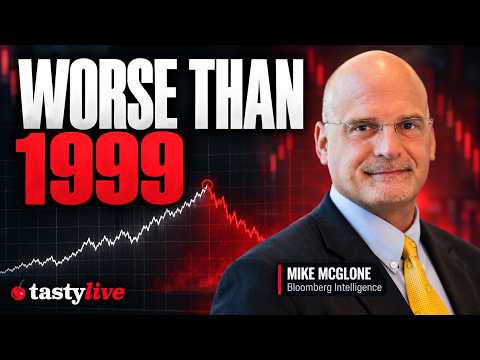
Mike Mc Glone Says The Stock Market Is Pure Noise Until It Rolls Over
https://www.youtube.com/watch?v=fFYh9Wqdeck
TLDR Mike McGlone warns that overheated stocks, high yields, and rising energy prices could give way to a broad downturn, with recession risks pulling down Bitcoin, gold, metals, and other risk assets. He favors Treasuries as a defensive investment, remains bearish on Bitcoin and gold, and says a sharp S&P 500 decline could expose the market’s fragility.
Start by Assessing Interest Rates and Treasury Yields
Compare the potential return on risk assets with the income available from Treasuries. Strategist Mike McGlone argues that yields near 5% can make assets that pay no income, including gold and Bitcoin, less appealing. He views long-term bonds as a possible defensive holding if equities decline. Treat this as a market opinion, not a guarantee: bond prices can fall when yields rise, so consider interest-rate risk and your investment timeline.
Watch Energy Prices for Inflation and Economic Warning Signs
Track crude oil alongside inflation, consumer affordability, and central-bank decisions. McGlone warns that persistently high energy prices could strain household budgets, increase recession risks, and keep policymakers cautious about cutting rates. He also believes oil may not stay at elevated levels over the coming year, particularly if political pressure or easing supply constraints weigh on prices. Use multiple indicators rather than relying on oil alone to predict the economy.
Check Whether a Stock Rally Is Supported by Broad Fundamentals
Strong earnings and rising share prices can reinforce each other, but a rally can become vulnerable when valuations and investor expectations climb too far. McGlone compares current market enthusiasm with the late-1990s boom and points to high stock-market valuations relative to measures such as GDP. He also cautions that earnings and technical signals may not prevent a reversal once a market reaches an extreme. Review valuation, earnings quality, and market breadth instead of treating recent gains as proof of lasting strength.
Monitor Volatility and Correlations Across Asset Classes
Look beyond each asset’s price and check how it behaves when other markets move. McGlone highlights an unusual gap between low stock volatility and higher volatility in gold, silver, and crude oil, and worries that equity volatility could rise to catch up. He also says metals and Bitcoin have become closely correlated with stocks, which may limit their usefulness as diversifiers during a sell-off. Periodically test how your portfolio might respond to a simultaneous decline across several assets.
Treat Commodity Surges as Potential Turning Points, Not Permanent Trends
A sharp rise in a commodity can eventually encourage changes in supply and demand that reverse the move. McGlone argues that recent gains in metals and energy could mark a market peak rather than a lasting plateau, and points to falling U.S. natural-gas prices as a possible sign of easing pressure. He is bearish on gold after its rapid rally and says he would reassess it near $3,000, while rejecting a rise to $5,000 as a reason to change his view. These price levels reflect his stated outlook, not universal buy-or-sell signals.
Use Relative Strength to Evaluate Bitcoin and Other Risk Assets
Compare Bitcoin’s performance with equities during a market downturn instead of judging it only by its latest rebound. McGlone says he would reconsider his bearish outlook if Bitcoin showed sustained strength relative to the S&P 500 under pressure. He views a rebound as a potential opportunity to reduce exposure and warns that cryptocurrencies may remain highly correlated with other risk assets. Because crypto prices can be volatile and tokens differ widely, assess position size and the possibility of substantial losses.
Build a Defensive Plan Before Markets Turn
Set clear limits for portfolio risk before a correction begins, rather than reacting only after prices fall. McGlone warns that a 10–20% S&P 500 decline could affect other markets and the broader economy, while rising long-term yields and weakening housing may signal tighter financial conditions. Consider whether your holdings are concentrated in assets that move together and whether you have enough liquidity for near-term needs. His bearish forecasts are scenarios, not certainties, so balance defensive measures with your goals, time horizon, and risk tolerance.
Why does Mike McGlone believe Treasury yields near 5% are significant for markets?
He sees them as an inflection point and believes the yields make non-income-producing assets such as gold, Bitcoin, and commodities less attractive. He views Treasuries as offering the best risk-reward and a potential refuge if stocks fall.
What is McGlone’s outlook for crude oil and energy prices?
He expects oil prices are unlikely to stay at current highs over the coming year. He argues that persistently expensive energy could worsen affordability, increase recession risks, and keep central banks vigilant. He also believes the recent rise in metals and energy may be a peak rather than a lasting plateau.
Why is McGlone bearish on stocks?
He sees strong earnings and market gains as a self-reinforcing frenzy reminiscent of 1999, with elevated valuations relative to GDP, public debt, international equities, and commodities. He warns that the rally could be undone by its own excess and that a significant S&P 500 decline could affect markets and the wider economy.
What does McGlone think about the relationship between stock volatility and volatility in commodities and precious metals?
He is concerned that stock volatility is unusually low while volatility in gold, silver, and crude oil has surged. He expects stock volatility may eventually catch up, and says metals have become highly correlated with equities.
What is McGlone’s current view on gold?
He is defensive and bearish, despite having been bullish on gold for decades. He considers gold’s rapid rally during disinflation and its extreme levels relative to other assets concerning. He would reconsider gold near $3,000, but not if it rises to $5,000.
Why does McGlone see risks for copper and other metals?
He points to copper’s record correlation with the S&P 500, rising interest rates, and low Chinese bond yields that suggest deflationary pressure. He believes the sharp rise in metals may have reached an apex.
How could the U.S. midterm elections affect energy prices and bonds?
McGlone says a political backlash related to high energy prices and the Iran conflict could be negative for energy prices but positive for bonds.
Why does McGlone doubt that forecast GDP growth is sustainable?
He argues that data-center investment is driving activity, while consumer spending—about 68% of the economy—is much larger than business investment, at 14%. He also warns that debt-financed government spending is supporting growth and could eventually give way to austerity.
What is McGlone’s outlook for Bitcoin?
He remains bearish and says Bitcoin could fall to $10,000, especially if the S&P 500 declines. He views recent rebounds as opportunities to sell and says he would reconsider only if Bitcoin shows strength relative to the S&P 500 during a downturn. He also expects many tokens to be wiped out before any potential reset.
What market signals does McGlone see as warning signs of a broader downturn?
He cites rising long-term bond yields, weakening housing and cryptocurrencies, and potentially peaking precious metals. He also warns that a prolonged S&P 500 decline could signal a global recession and carry a high risk of a U.S. recession.
What trade does McGlone suggest investors may consider if markets weaken?
He suggests that liquidating Bitcoin and moving into long-term bonds could become a major trade.
 Michelin Star Beef Short Ribs at Home...
 FUTURE IRAN WAR PLAN - IT's INSANE...
 Bill Gates: A.I. ‘Makes Nuclear Weapons Look Like N...
 Mike McGlone Says the Stock Market Is Pure Noise Un...
 "I've Never Seen Anything Like This Before..." - Ed...
 Timothy Snyder Told Me What Trump Plans After Nov. ...